Why Do People Choose Medical Tourism?
Medical Tourism Cost Calculator
Calculate Your Savings
More than 2 million people traveled outside their home countries for medical care in 2024. That’s not a small number-it’s growing every year. And it’s not just rich people doing it. Middle-class families, retirees, even people with good insurance are crossing borders for treatment. Why? The answer isn’t one thing. It’s a mix of cost, waiting times, access, and sometimes, just better results.
Cost is the biggest driver
Let’s be real: healthcare in the U.S., Canada, and parts of Europe can be brutal on the wallet. A knee replacement in the U.S. averages $50,000. In Thailand, it’s around $14,000. In India, you can get it for $8,000-with the same hospital accreditation and same surgeon training. That’s not a discount. That’s a life-changing savings.
And it’s not just surgery. A spinal fusion in the U.S. costs nearly $100,000. In Mexico, it’s under $20,000. Dental implants? $4,000 in the U.S. vs. $800 in Hungary. Even cosmetic procedures like rhinoplasty or breast augmentation are often half the price-or less-in countries like Brazil, Turkey, or South Korea.
People aren’t just saving money. They’re saving entire chunks of their life savings. One woman from Ohio paid $12,000 for a hip replacement in India. Her U.S. quote was $48,000. She didn’t just get the surgery. She got her retirement fund back.
Waiting lists are killing people
In the UK’s NHS, the average wait for non-emergency hip surgery is over 18 months. In Canada, it’s more than a year for many procedures. For someone in pain, that’s not patience. That’s suffering.
People don’t want to sit on a waiting list while their condition gets worse. A man from Toronto with chronic back pain flew to India for a discectomy. He waited six months in Canada. In India, he was scheduled within two weeks. He was walking without pain in six weeks.
When you’re dealing with degenerative conditions, time isn’t just inconvenient-it’s critical. Medical tourism isn’t just about saving money. It’s about saving mobility, independence, and quality of life.
Access to treatments not available at home
Some treatments simply don’t exist in certain countries-or they’re banned. Stem cell therapies for spinal cord injuries, certain types of fertility treatments, or experimental cancer protocols are legal and available in places like Mexico, Ukraine, or India-but not in the U.S. or Germany.
One couple from Australia spent two years trying to get IVF with donor eggs under their national health plan. They were denied because of age limits. They went to Ukraine. They got the treatment. They had twins. Their story isn’t rare. It’s common enough that clinics in Eastern Europe now have dedicated international patient coordinators.
Even for things like gender-affirming surgery, access varies wildly. In some U.S. states, minors can’t get care. In Thailand or Canada, the process is smoother. People travel not because they want to, but because they have to.
Better quality and newer technology
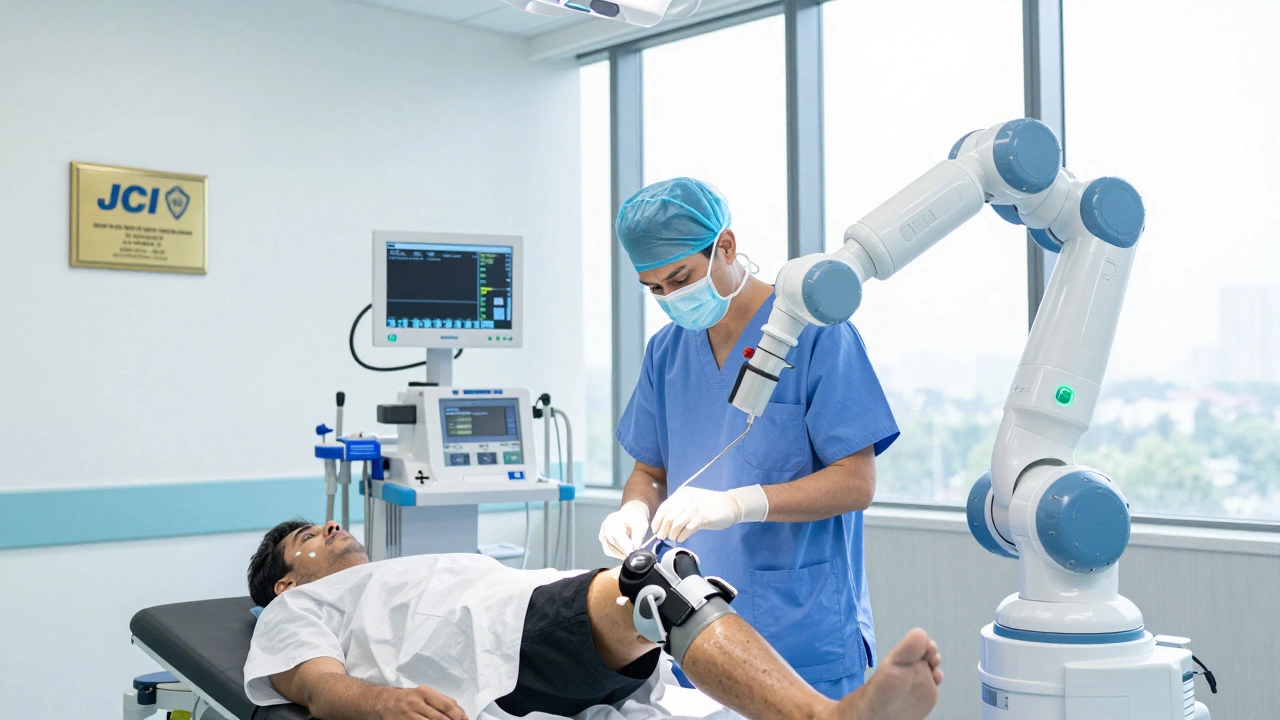
There’s a myth that care abroad is lower quality. That’s outdated. Many hospitals in Thailand, India, Singapore, and Turkey are Joint Commission International (JCI) accredited-the same standard used in U.S. hospitals. Some even have more advanced equipment because they’re newer facilities.
For example, India’s Apollo Hospitals in Hyderabad uses robotic-assisted surgery systems that were installed in 2022. The same machines in U.S. hospitals are often older because of slower adoption cycles. In Mexico, clinics in Monterrey have the latest MRI and CT scanners, imported directly from Germany and Japan.
Doctors in these countries often train in the U.S. or the U.K. and return home to work. They speak English. They’ve seen more cases than their counterparts in smaller U.S. towns. One cardiologist in Delhi told a patient from Michigan, “I’ve done 1,200 angioplasties. You’re my 12th patient this month.”
Privacy and anonymity matter
Some people travel because they don’t want anyone to know what they’re doing. Mental health treatments, addiction recovery, fertility procedures, or cosmetic surgeries are often stigmatized in their home communities.
A teacher from Texas flew to Colombia for a facelift. She didn’t tell her coworkers. She told her family she was visiting a friend. No one asked questions. No one posted pictures on Facebook. She got the care she needed without the gossip.
Same with mental health retreats in Costa Rica or rehab centers in Portugal. People go to escape judgment. They go to heal without being labeled.

It’s not just about the procedure-it’s about the experience
Medical tourism isn’t just a hospital stay. It’s a package. Many clinics offer recovery stays in resorts, airport transfers, translators, and even guided tours. You get your surgery, then you rest on a beach in Bali. Or recover in a mountain villa in Georgia. Or take a week off in Prague after your heart surgery.
People come back not just healed-but refreshed. One man from Canada had a bypass in Poland. He spent three days in the hospital, then ten days in a quiet guesthouse near Krakow. He walked the old city, ate pierogi, drank tea with locals. He said, “I didn’t just get my heart fixed. I got my life back.”
It’s not risk-free-but the risks are manageable
Yes, traveling for surgery carries risks. Infection. Language barriers. Follow-up care. But people aren’t flying blind. They research. They check accreditations. They use medical travel agencies with real track records. They read reviews from real patients-not just clinic marketing pages.
Reputable clinics provide pre-travel consultations via Zoom. They send lab reports in English. They coordinate with your home doctor. Some even offer telehealth follow-ups after you return. The industry has matured. It’s not the Wild West anymore.
The biggest mistake? Choosing based on price alone. The smartest travelers choose based on credentials, communication, and consistency. They look for JCI, ISO, or NABH accreditation. They ask for surgeon experience numbers. They want to see real patient photos (not stock images).
Who’s doing it-and why now?
It’s not just Americans. Australians, Brits, Scandinavians, and even people from Gulf countries are traveling for care. Why now? Because the infrastructure is here. Flights are cheaper. Communication is instant. Payment systems are secure. Insurance companies are starting to cover parts of it.
And social media? It’s changed everything. People see videos of others recovering in Thailand, posting with their new smile or walking without a cane. They don’t just hear about it-they see it. And that’s powerful.
Medical tourism isn’t a fringe trend. It’s a quiet revolution in how people think about healthcare. It’s not about abandoning your system. It’s about taking control of your health, on your terms.